


Helping Teachers Introduce AI and Cybersecurity Without Fear

Many educators today are being asked to teach concepts related to artificial intelligence, digital literacy, cybersecurity, and emerging technologies, even when they may not have formal technical backgrounds themselves.
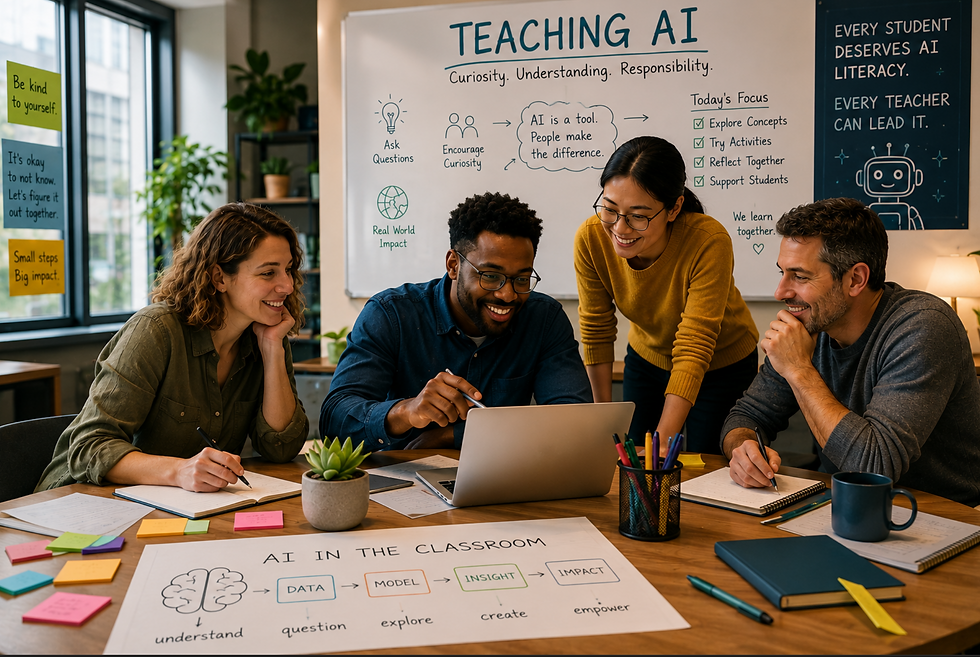
One of the most important findings highlighted by research from the Raspberry Pi Foundation and Google DeepMind is that educator confidence dramatically improves when teachers are provided with accessible, practical, and beginner friendly resources.
This matters deeply for underserved communities.
In many low income schools and community programs, educators often carry enormous responsibilities with limited resources. Technology education can sometimes feel intimidating because AI and cybersecurity are evolving so quickly. However, the research shows something encouraging:
Students do not need perfect experts.They need supportive adults willing to learn alongside them.
At GIA CYBER, we strongly encourage educators and community leaders to approach AI and cybersecurity education with curiosity rather than pressure.
Some of the most effective strategies highlighted in the research include:
Teaching through hands on activities rather than technical lectures
Encouraging critical thinking over memorization
Using real world examples students already recognize
Focusing on responsible technology use and digital safety
Creating collaborative environments where students problem solve together
The report also emphasizes that young people are already interacting with AI systems daily through:
Social media algorithms
Chatbots
Recommendation systems
Search engines
Video platforms
AI generated media
Because of this, AI literacy is becoming just as important as traditional digital literacy.
Teachers do not need advanced engineering knowledge to begin these conversations.
Simple discussions around:
How AI makes decisions
How misinformation spreads
Why online safety matters
How recommendation systems influence behavior
What responsible AI use looks like
can already create meaningful educational impact.
The research further highlights that students respond best when STEM and AI learning feels approachable, creative, and connected to real life. Activities involving robotics, beginner coding, cybersecurity awareness, and practical AI demonstrations consistently improve student engagement and confidence.
At GIA CYBER, we believe community organizations, libraries, schools, and nonprofits play a critical role in helping bridge the technology opportunity gap for underserved youth.
Technology education does not have to start with expensive labs or advanced certifications.
Sometimes it starts with:
One teacher willing to try
One library workshop
One after school STEM activity
One conversation about online safety
One student discovering confidence through technology
That is how stronger futures begin. :)


Comments